
Commercial Property Depreciation: How It Works in Australia
General information only, not financial, tax or legal advice. Depreciation rules, effective lives, write-off thresholds and the dates that determine eligibility change over time and depend on the asset, the building and your ownership structure. Speak to a licensed adviser about your own situation.
TL;DR
Commercial property depreciation is the deduction you claim for the wear and tear on a building you own and the assets inside it. It splits into two buckets. Division 43 capital works covers the structure, slab, walls, roof, car park and fixed improvements, written off slowly over decades. Division 40 plant and equipment covers removable assets such as air conditioning, lifts, carpet and security systems, written off faster over each item's effective life. Commercial owners get a materially better deal than residential owners, because the 2017 restriction on second-hand plant and equipment never applied to commercial property. A qualified quantity surveyor prepares the schedule. It is a timing benefit, not free money.
What commercial property depreciation actually is
Depreciation is a non-cash deduction. You do not write a cheque for it. The ATO accepts that a building and its fittings lose value as they age, and lets you claim that decline against your income each year.
That makes it unusual. Most deductions cost you money before they save you money. Depreciation reduces your taxable income without touching your bank account, and because no invoice arrives, nobody chases it. An owner can hold a property for years, claim every outgoing and rate correctly, and still leave the largest deduction on the table.
The two buckets: Division 43 and Division 40
Every claim sits in one of two divisions of the tax law, and which bucket an item falls into tells you how fast you can claim it.
Division 43: the capital works deduction
The capital works deduction under Division 43 covers the building itself and anything structural or permanently fixed: concrete, brickwork, roofing, windows, doors, fixed partitions, bathrooms, sealed car parks, fencing and in-ground services.
It is claimed at a flat rate on the original construction cost, not on what you paid for the property. For non-residential buildings the rate is commonly 2.5% a year over forty years, with 4% over twenty-five years available for some building types, including certain industrial premises and short-term traveller accommodation. Confirm which applies with your quantity surveyor.
Division 43 is also date-gated. Broadly, construction of a non-residential building needs to have commenced after 20 July 1982 to qualify, and later structural improvements carry their own dates, so an older building renovated since can still hold a solid claim.
Division 40: plant and equipment depreciation
Plant and equipment depreciation under Division 40 covers the assets that are not part of the building fabric: air conditioning units, lifts, hot water systems, carpet, blinds, light fittings, fire and security systems, appliances, roller doors and loose furniture.
Each asset is depreciated over its own effective life rather than at a single flat rate. You generally choose between the prime cost method, which claims the same amount each year, and the diminishing value method, which front-loads the deduction. The choice is made per asset and locked in once you start.
Thresholds for writing off low-cost assets immediately or pooling them also exist and have moved repeatedly. Check the current figure with your accountant each year.
What it covers: Division 43 capital works: Structure and fixed improvements; Division 40 plant and equipment: Removable and mechanical assets
Basis of claim: Division 43 capital works: Original construction cost; Division 40 plant and equipment: Cost or apportioned value of each asset
Speed: Division 43 capital works: Slow, decades; Division 40 plant and equipment: Faster, by effective life
Method choice: Division 43 capital works: Flat rate, no choice; Division 40 plant and equipment: Prime cost or diminishing value
Second-hand assets: Division 43 capital works: Claimable; Division 40 plant and equipment: Claimable for commercial
Effect at sale: Division 43 capital works: Reduces your CGT cost base; Division 40 plant and equipment: Handled under its own balancing rules
Why commercial is better than residential on depreciation
In 2017 the rules changed for residential property. Investors who bought an established dwelling lost the ability to claim depreciation on second-hand plant and equipment, so the previous owner's air conditioner, carpet and blinds became worthless for tax purposes in the new owner's hands.
That restriction never applied to commercial property. Buy a warehouse, a medical suite, a childcare centre or a strip retail shop, and the existing plant and equipment is still depreciable in your hands, subject to apportionment.
That matters because commercial buildings are plant-heavy. A fitted medical premises carries far more mechanical and fit-out value as a share of price than a house ever will, and more value in the fast bucket means more deduction early. It is one of several places the arithmetic differs, along with how yields are quoted.

Who prepares a depreciation schedule for commercial property
A depreciation schedule for commercial property is prepared by a qualified quantity surveyor who is also a registered tax agent. It is a one-off document, typically covering the building's full forty-year life, and the fee is deductible.
The surveyor inspects the property, identifies and values every depreciable asset, estimates the original construction cost where it is unknown, and sets out the deduction available each year under both divisions.
Why your accountant generally cannot do this
This is not a slight on accountants. The ATO's position is that where construction costs are not known, they must be estimated by an appropriately qualified person, and estimating construction cost is a quantity surveying discipline, not an accounting one.
Accountants, property valuers and agents are not regarded as qualified to produce those estimates. Your accountant then uses the schedule to prepare the return. The roles are complementary, not interchangeable.
Scrapping: the deduction inside a refurbishment
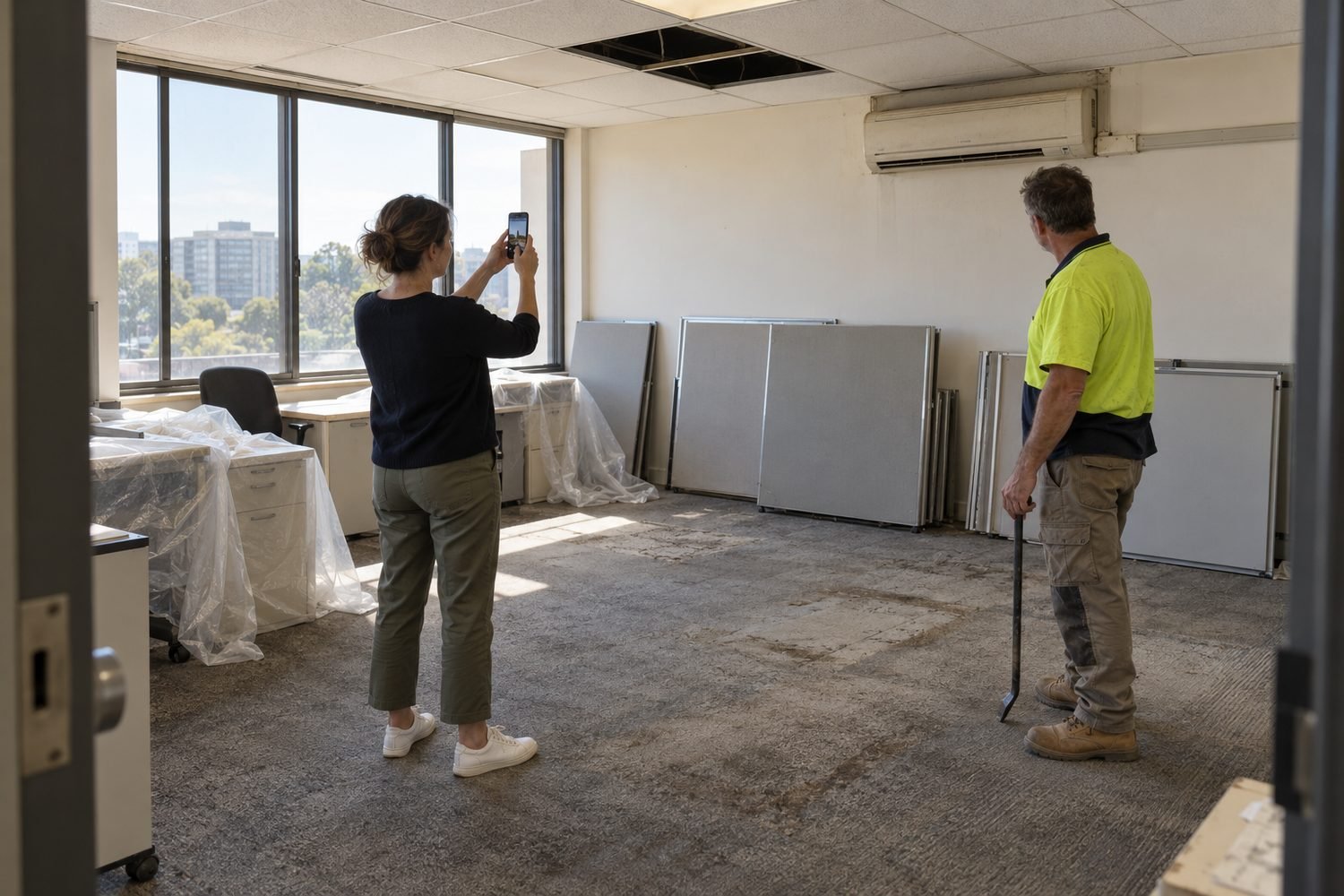
Scrapping is where depreciation and a value-add strategy meet. When you remove an asset that still has undeducted value, the remaining written-down value can generally be claimed in the year of removal rather than over years.
Rip out old carpet, tired partitioning or an end-of-life air conditioning system, and those residual values can come forward into a single year. Demolished capital works can also give rise to a balancing deduction for the undeducted construction expenditure.
The condition is documentation. The assets must be identified and valued before they are removed, so the schedule needs to exist before the demolition crew arrives. An owner who refurbishes first and calls the quantity surveyor second has usually lost the claim. If your plan is to buy something underdone and improve it, build this into the sequence in how to buy commercial property.
Fit-out: landlord or tenant, and who claims what
In commercial property the fit-out is often not yours. Whoever owns an asset claims the depreciation, and ownership follows the lease and the works agreement, not who occupies the space.
Landlord-owned fit-out, such as base building services and anything the lease treats as the lessor's property, is claimed by the landlord.
Tenant-funded fit-out the tenant owns and can remove is claimed by the tenant as their own plant and equipment or capital works.
A cash incentive or rent-free period contributed toward a tenant's fit-out has its own tax treatment and does not automatically give the landlord a claim.
Where a tenant leaves fit-out behind at lease end, the answer depends on the lease terms and the amount the landlord is treated as having incurred.
Have the lease, the works schedule and the depreciation schedule read together. Ownership detail changes the answer here, as it does with your ownership structure.
Cash flow versus taxable income
Depreciation changes your taxable income without changing your cash. A property can be putting money in your pocket monthly and still report a much smaller taxable profit, because the deduction sits between the two.
As a generic example, say a property at $1.2 million on a 7% net yield produces $84,000 in net rent. If the schedule supports $25,000 of combined Division 43 and Division 40 deductions in year one, the cash received is unchanged, but the income you are taxed on is far lower.
That is the practical appeal. It improves the after-tax return on a property that already works on its own numbers, and it does not rescue one that does not.
Depreciation sits alongside the other commercial property tax deductions you would expect: interest, rates, land tax, insurance, management fees, repairs and professional fees. It is the one that needs a specialist to unlock.
The catch at sale: capital gains tax
Here is the part the enthusiastic version of this story skips. Capital works deductions claimed under Division 43 generally reduce your capital gains tax cost base. Claim $200,000 of capital works and your cost base falls by broadly that amount, so the capital gain at sale is larger. Plant and equipment is handled through its own balancing adjustment on disposal instead.
So depreciation is a deferral. You take the deduction at your marginal rate now and give some of it back later. Whether you come out ahead depends on the rate you claimed at, the rate the gain is taxed at, any capital gains discount available to your structure, and how long the money was working for you.
For most owners that deferral is valuable. It is still a deferral, and anyone presenting depreciation as money the ATO is giving you has skipped a step.
Depreciation should never be the reason you buy
A depreciation schedule can turn a good commercial property into a better one after tax. It cannot turn a bad one into a good one. If the tenant is weak, the lease is short, or the price assumes a yield the market will not sustain, no deduction fixes that.
Buy on the lease covenant, the tenant, the location and the exit. Then claim everything you are entitled to, including depreciation, and get the other mechanics right, from stamp duty to GST.
Where to go from here
Depreciation is one piece of a larger picture. Returns on commercial property come from the lease, the tenant and the structure of the deal, with tax treatment amplifying a good decision rather than creating one. Our pillar guide on commercial property investing in Australia shows how the parts fit together.
If you would rather see it explained than read it, Cal Doggett's Fortify Your Wealth video series is at https://investorcode.com.au/fortify-your-wealth-series, and the Commercial Property Mastery course at https://investorcode.com.au/online-course goes deeper into the numbers behind a purchase. Cal has spent 20+ years in Australian commercial property and has transacted more than $550M.
Frequently asked questions
Can I claim depreciation on an old commercial building?
Often yes. The structure needs to meet the qualifying construction dates for Division 43, broadly after 20 July 1982 for non-residential buildings. Even where the original structure misses out, later renovations and structural improvements can qualify, and the plant and equipment inside an older building is usually depreciable regardless of age.
How much does a depreciation schedule for commercial property cost?
Fees vary with the size and complexity of the building and the number of tenancies, so get a quote for your property. The fee is a one-off cost and is tax deductible. A reputable quantity surveyor will tell you upfront if the expected deductions would not justify the engagement.
Do I lose depreciation on second-hand plant and equipment?
Not for commercial property. The 2017 change that stopped investors claiming second-hand plant and equipment applied to residential rental properties only. When you buy an existing commercial building, the existing assets remain depreciable in your hands, subject to the usual valuation and apportionment rules.
Can I backdate missed depreciation claims?
Usually you can amend prior year returns, subject to the ATO's amendment time limits, which are commonly two years for most individuals and small businesses and longer in some circumstances. Have the quantity surveyor prepare the schedule from the date you acquired the property, then ask your accountant which years can still be amended.
Does claiming depreciation increase my tax at sale?
Capital works deductions reduce your capital gains tax cost base, so claiming them does increase the capital gain calculated at sale. Plant and equipment is dealt with through its own balancing adjustment on disposal. The benefit is timing, deductions now against a larger assessable gain later, which for most owners is still worth having.