
Commercial Property Due Diligence: Two Questions That Cover 90% of It
TL;DR
Due diligence on a commercial property can absorb a lifetime, but the value is concentrated in three areas: the property, premises and location, the tenant and the lease, and the market, both local and global.
You can cover about 90% of it with two questions.
First, if I lose this tenant now, how quickly will I find a replacement and what protection do I have?
Second, if I lose this tenant when the lease expires, how quickly will I find a new one, and will the asset be worth more or less?
Answer those honestly and you uncover vacancy rates, likely downtime, incentives, make good, achievable rent and lease term, which is most of what actually drives the outcome.
The whole discipline is about being comfortable saying no to 999 properties out of 1,000.
Watch the full video
Due diligence is the habit of saying no
I have never lost a dollar in commercial property, and the reason is not that I find better deals than everyone else. It is that I am comfortable walking away. The framework here is built to say no to 999 out of 1,000 properties, so that the one you keep is one you understand completely.
Get into the habit of interrogating information and being willing to walk, and the returns take care of themselves.
Due diligence sits at step four of the six-step framework, right alongside finance, and it is where you either confirm the story your feasibility told you or discover the reasons to move on.
The three things you must understand
The property, premises and location. The premises is the four walls and the roof and whatever else comes with it. The location is fixed the moment you buy, so it has to be right. Understand the land itself, the structural integrity of the building and its fabric over time.
A technical due diligence report, roughly seven to twelve thousand dollars, puts a specialist across the roof, the air conditioning, the fire services, compliance, accessibility and the real condition of everything you are inheriting. Understand any risk that runs with the land: contamination, a flight path, cables, a council road-widening reservation.
Risk and opportunity travel together, and a zoning change can turn a $150 per square metre industrial rent into a $300 retail one. Council websites and their planning maps tell you most of this for free.
The tenant and the lease. If there is a tenant, there is a lease, and if there is not, that is a red flag. Read the lease yourself before you hand it to a lawyer.
Most of it is plainer than it looks, and doing your own pass means you can compare conclusions and catch what a reviewer might miss. Confirm it is executed correctly by the right parties, then check that what is written is actually what is happening.
Rents get escalated incorrectly, areas get measured wrong, mezzanines go unrecorded, and fit-out ownership hides in the clauses.
Then assess the tenant: are they trading in a way that fits the lease, and will they stand the test of time?
Ask for their performance history where the lease allows it. Financial accounts tell a story that anecdotes never will.
The market, local, national and global. Offices were hit hard through COVID, which is a clean example of a global shift repricing an asset class. Petrol stations face electric-vehicle headwinds. Retail carries online pressure, while cold storage near cities gained from food delivery.
Zoom out to the big movers of supply and demand, then zoom back in to the street: is this corner better than that one, can drivers even see the premises, what is available two doors down. And above all, compare the passing rent you are receiving to the market rent an equivalent premises would command.
That single differential is often the biggest upside or the biggest risk in the deal.
The two questions that cover 90%
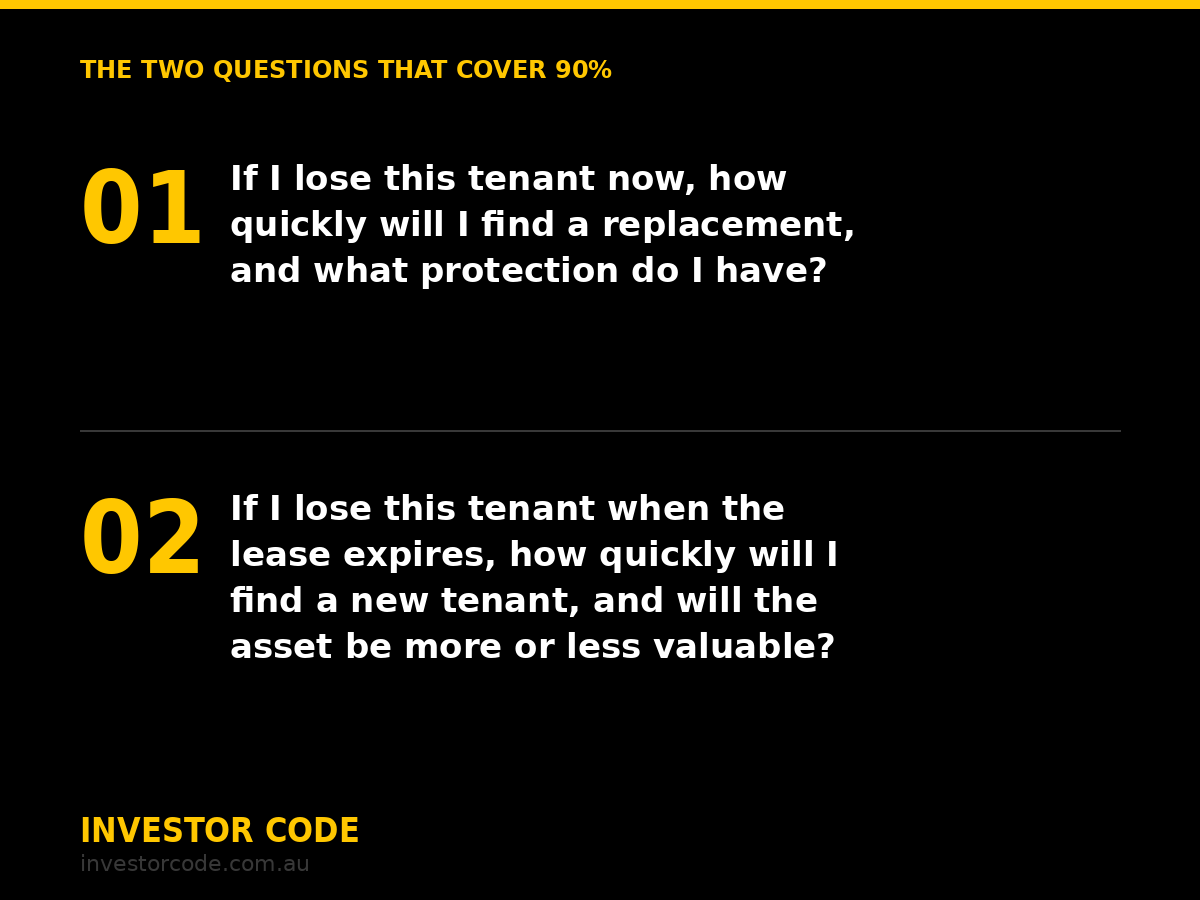
Here they are, and underneath each sit ten smaller questions that most of your due diligence quietly answers.
Question one: if I lose this tenant now, or if the premises is vacant now, how quickly will I find a replacement, and what protection do I have from this eventuality?
Question two: if I lose this tenant when the lease expires, how quickly will I find a new tenant, and will the asset be more or less valuable?
Work through those honestly and you uncover the things that actually decide the return: the vacancy rate in the area, the likely rental downtime, the incentive needed to attract a tenant, the marketing and agency cost of re-leasing, the make good the outgoing tenant owes you or that you will have to fund yourself, any works needed to bring the premises to standard, the process of securing a new tenant, the quality of tenant you can expect, the market rent you will achieve, and the lease term you can realistically sign. Some streets fill a vacancy in a week with five applicants.
Others have vacancy to the left, the right and across the road. Knowing which one you are buying is the difference.
Where to find the answers
You do not need to spend a fortune to answer these. Valuers, technical due diligence specialists, lawyers and specialist leasing agents will tell you almost everything, because in this industry people trade information freely right up until a transaction is done.
The big agencies publish quarterly vacancy, rent and incentive reports for office, retail, industrial, childcare and more, for free. Councils publish zoning and long-term plans.
And a well-briefed AI can summarise a planning report or a cost benchmark in minutes.
Ask a retail leasing agent about retail, an office valuer about office, and the busiest childcare transactor about childcare. Reach out, because their next commission depends on helping you now.
Where to go from here
Most people start with Cal’s Fortify Your Wealth series, a multi-part video series on the strategies he uses when the market shifts, with weekly videos on YouTube.
When you are ready for the full framework, that is the Commercial Property Mastery online course.

Frequently asked questions
What is commercial property due diligence?
It is the investigation you run before settlement to confirm what you are buying: the property, premises and location, the tenant and the lease, and the market. The goal is to uncover every risk and opportunity while you still have the option to walk away.
What are the two key due diligence questions?
First, if I lose this tenant now, how quickly will I find a replacement and what protection do I have? Second, if I lose this tenant when the lease expires, how quickly will I find a new one, and will the asset be worth more or less? Together they cover about 90% of what matters.
How much does commercial property due diligence cost?
A technical due diligence report is typically $7,000 to $12,000, with additional costs for legal review, searches, valuations and specialist reports. Much of the market information you need, such as vacancy and incentive data, is available free from published agency reports.
What is passing rent versus market rent?
Passing rent is what the tenant currently pays. Market rent is what an equivalent premises would achieve on the open market. The gap between them is often the single biggest source of upside or risk in a deal.
Should I read the commercial lease myself?
Yes. Read it yourself first, then have a lawyer review it. Doing your own pass means you understand the asset and can compare conclusions, which sometimes catches things a reviewer misses.
How long does due diligence take?
It varies with the deal and the due diligence period negotiated, often 30 to 60 days. The two-question framework lets you concentrate on the issues that drive the most value if your time is limited.