
Commercial Property Zoning in Australia: What a Building Is Allowed to Be
General information only, not financial, tax or legal advice. Planning controls are set by state legislation and local council planning schemes, they change regularly, and the rules applying to one property do not carry across to another. Speak to a licensed adviser about your own situation.
TL;DR
Commercial property zoning is the planning control that decides what a building may lawfully be used for. Planning is administered under state legislation and delivered through local council planning schemes, so zone codes and their meanings differ between states. Every use falls into one of three buckets: permitted as of right, permitted only with council consent or a planning permit, or prohibited. A broad permitted use means a deeper tenant pool and lower vacancy risk. A narrow one means fewer possible tenants and a harder re-let. Check the actual planning scheme for the actual title, read the overlays, order a planning certificate, and treat zoning as a due diligence item rather than an assumption.

Why commercial property zoning decides what a building is worth
Zoning decides what a building may lawfully be used for. That decides who can lease it. Who can lease it decides the rent, the vacancy risk and the price.
Two identical warehouses on one street can be worth materially different amounts, because one sits in a zone where a gym, a medical practice and a trade supplies business are all possible, and the other does not.
It is also where first time commercial buyers get caught. A house is a house, so residential investors rarely think about use. Carry that assumption across and you can buy a building that cannot legally do the thing you bought it for.
Zoning Australia explained: two layers, not one
There is no national zoning system. Planning is a state and territory responsibility, delivered through two layers.
State legislation and policy sets the framework, the assessment pathways and the matters councils must weigh.
The local planning scheme applies that framework to actual parcels of land. Your council's scheme or local environmental plan maps which zone each property sits in, and tables what each zone allows.
So a zone code in one state does not mean the same thing in another, and may not exist there at all. Read the scheme that applies to the property in front of you.
Two jurisdictions differ in form. South Australia runs a single statewide Planning and Design Code rather than separate council schemes. The Australian Capital Territory layers its Territory Plan over Crown leases, where the lease purpose clause also limits use.
Why B1, B2 and IN1 zoning may not say what you think
Those codes come from the New South Wales standard instrument, where B covered business zones and IN covered industrial. New South Wales has since moved to employment zones using E and MU codes, so older listings quoting B1 or B2 may describe superseded controls. They were never used in the other states. Confirm the zone from the council scheme, not the brochure.
The broad families of zone
Zones group into recognisable families even though names and codes vary. Orient yourself here, then verify the actual code and use table for the property.
Commercial and business: What it typically supports: Shops, offices, food premises, services; Example codes you may see: Commercial 1 and 2 in Victoria, centre zones in Queensland, E and MU zones in New South Wales
Industrial: What it typically supports: Warehousing, manufacturing, transport, trade supplies; Example codes you may see: Industrial 1, 2 and 3 in Victoria, low to high impact industry in Queensland, light and general industrial elsewhere
Mixed use: What it typically supports: Residential above commercial, higher density centres; Example codes you may see: Mixed use zones, activity centre zones in Victoria
Special use: What it typically supports: Hospitals, schools, utilities, places of worship; Example codes you may see: Special use or special purpose zones
Community and public: What it typically supports: Council facilities, recreation, public land; Example codes you may see: Community facilities and public use zones
Treat that as a map of concepts, not a lookup. The detail sits in the zone's own use table. For why industrial draws so much investor attention, see industrial property investment in Australia.
Permitted use, consent, or prohibited
Every scheme sorts uses into three categories. The labels differ, the logic does not.
Permitted as of right. Allowed without a planning permit, subject to conditions in the scheme. Western Australian zone tables mark these with a P, and Queensland calls the pathway accepted development.
Permitted with consent or with a permit. May be allowed, but only if you apply and council agrees. This is discretionary. Council can refuse, or approve with conditions you did not want.
Prohibited. Not allowed in that zone at all. No application fixes it, and a rezoning is slow, costly and uncertain.
Most investor risk sits in the middle category. Searches for permitted use commercial property surface the first one, while much real commercial activity sits in the second, where approval is possible but not certain and the conditions can change the economics.
Existing use rights: the current tenant is not your permission
A tenant operating lawfully today does not mean the next tenant can do the same thing.
The current use may rely on existing use rights, which protect a use that was lawful when it started but would not be permitted under the current scheme. They are narrow, they attach to that use, and they generally lapse if the use stops for a defined period. New South Wales commonly treats a discontinued use as abandoned after around twelve months and Victoria works on roughly two years, but the test varies and must be checked.
They rarely stretch to a different or materially intensified use. A mechanical workshop with existing use rights does not entitle the next tenant to run a panel shop or a late night venue.
So the question is not what happens here now. It is what could lawfully happen here if this tenant left tomorrow, which belongs on your commercial property due diligence checklist.
Change of use: what a planning permit involves
If the use you want sits in the consent category, you apply for a change of use planning permit, called a development application in some states. A typical application involves:
a submission addressing the zone purpose and the relevant scheme provisions
plans showing layout, floor areas, car parking and access
specialist reports where triggered, commonly traffic, acoustic, waste, contamination and heritage
public notification, where neighbours and affected parties can object
assessment, often a request for further information, then a decision with or without conditions
a right of review or appeal, heard by a tribunal or court depending on the state
Timing is the part people underestimate. A straightforward application with no notification and no objections might take two to four months. Add advertising, objections or an appeal and six to twelve months or more is realistic. If your purchase depends on a permit, that timeline belongs inside your contract conditions. See how to buy commercial property.
The traps that catch first time buyers
Zoning alone rarely breaks a deal. The controls around it usually do.
Car parking
Schemes set parking rates by use, usually spaces per unit of floor area. Warehouse to gym or medical can lift the requirement sharply. If the site cannot provide the spaces, you are asking council for a dispensation it may refuse.
Hours of operation
Permits often cap trading, delivery and plant hours. A tenant who needs early starts or late trade is unleasable in a building with restrictive hours, even where the use itself is permitted.
Signage
Signage is controlled separately and can be tightly limited near residential interfaces and in heritage areas. Retail and food tenants price visibility into their rent.
Heritage, flood and bushfire overlays
Overlays sit on top of the zone with their own requirements. Heritage overlays control demolition and external works. Flood overlays affect floor levels, fit out and insurance. Bushfire prone area mapping drives construction standards. None change the zone, all change what you can do and what it costs.
Contamination and environmental audits
Former industrial, service station and dry cleaning sites carry contamination risk. Shifting to a sensitive use, childcare and medical being the obvious examples, can trigger an assessment or audit first. In Victoria an environmental audit overlay can require a certificate or statement of environmental audit. These run for months.
Access and loading
A permitted use is worth little if trucks cannot service the site. Check turning paths, loading bay dimensions, crossovers and heavy vehicle restrictions.
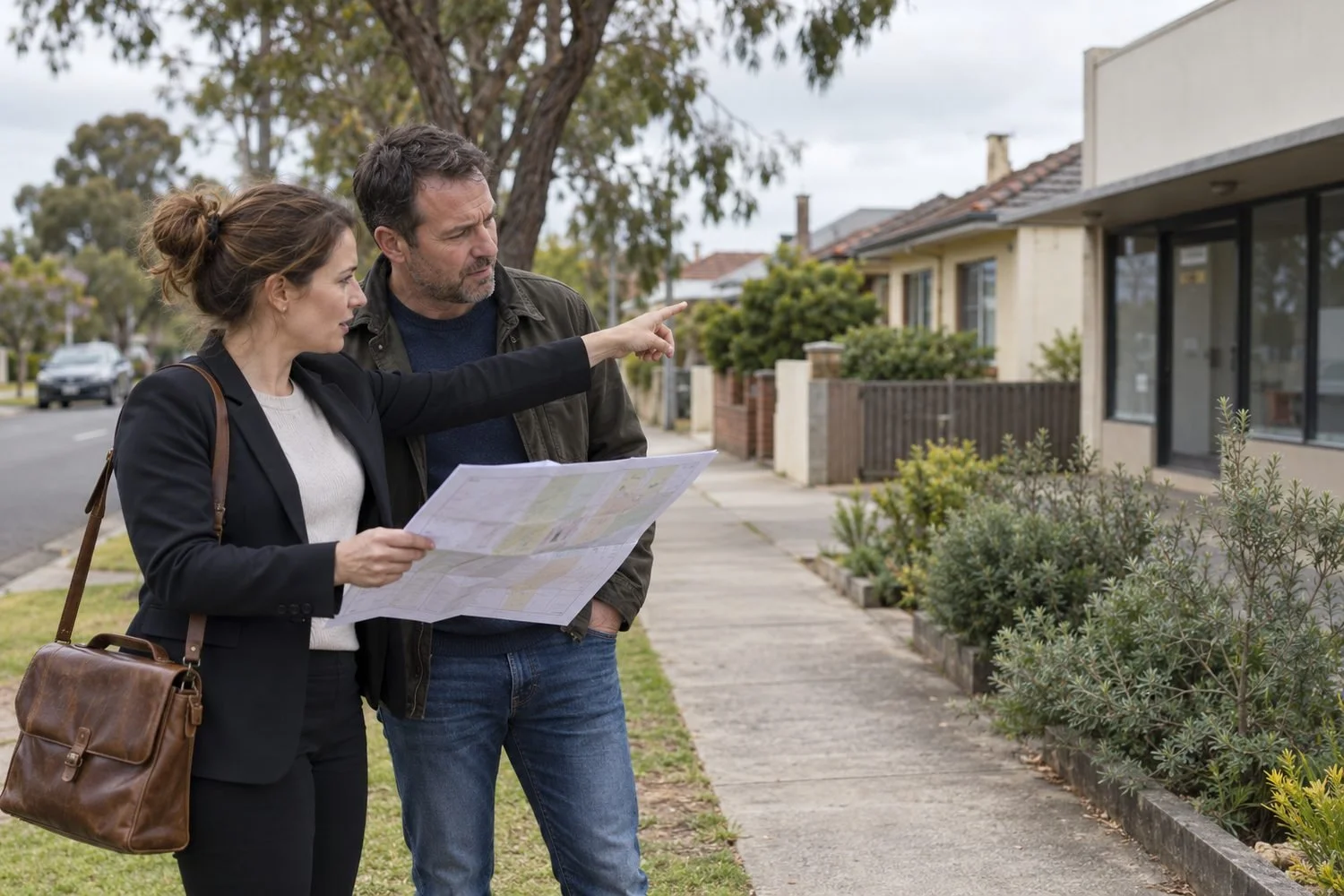
How to check commercial property zoning properly
Do this before the contract, not after.
Find the zone in the council planning scheme. Search the address on the scheme maps, then read the zone purpose and use table, not just the code.
Cross check on the state planning portal. Each state and territory runs an online mapping tool showing zones and overlays.
Order a planning certificate. A section 10.7 certificate in New South Wales, with equivalents elsewhere. It gives you the controls in writing from the authority.
Read the overlays line by line. Most cost surprises live here.
Engage a town planner for anything non obvious. If the use is discretionary or the building relies on existing use rights, a written planning opinion is cheap against the exposure.
Why a broader permitted use means less vacancy risk
Zoning sets the size of your tenant pool. A property where the zone permits retail, food, office, services and medical can be re-let to any of them. One permitting a narrow band can be re-let to very few.
At expiry the first owner has competing options, and the second has whoever wants that exact use in that exact location. That shows up in the time to re-let, in incentives and in rent. It also shows up in valuation, because a narrow use profile makes income look less reliable, which is why WALE in commercial property and use flexibility read together, and why zoning belongs inside how you value commercial property.
Permitted use also shapes who pays for what. Fit out, compliance upgrades and services capacity for a new use often land on the landlord, and interact with commercial property outgoings.
Zoning is a due diligence item. It is not an assumption, not what the agent says, and not what the current tenant happens to be doing.
Where to go from here
If you are working through your first commercial purchase, zoning sits alongside lease quality, tenant covenant and outgoings as one of the few things that determine the outcome. Our pillar guide to commercial property investing in Australia sets out how those pieces fit together.
Cal Doggett has spent 20 plus years in Australian commercial property and transacted around $550M over that time, and a consistent theme is that the deals which went wrong were knowable beforehand. The Fortify Your Wealth video series is a good place to start, and the Commercial Property Mastery course goes deeper into due diligence, lease analysis and valuation.
Frequently asked questions
How do I find out the zoning of a commercial property in Australia?
Search the address on your council's planning scheme maps, then cross check it on your state planning portal. For written confirmation, order a planning certificate from the council, a section 10.7 certificate in New South Wales. Read the use table and every overlay, not just the code.
What is the difference between permitted use and use requiring consent?
A permitted or as of right use is allowed without a planning permit, subject to scheme conditions. A use requiring consent may be allowed, but only if you apply and council agrees, which is discretionary and can bring conditions or a refusal. A prohibited use cannot be approved at all.
Can I change the use of a commercial property I own?
Usually yes, if the use is permitted with consent in that zone. You apply for a change of use planning permit or development application, with plans and any specialist reports your proposal triggers. If the use is prohibited, a permit will not help and you are looking at a rezoning.
How long does a change of use planning permit take in Australia?
A straightforward application with no notification and no objections often takes two to four months. Add advertising, objections, a request for further information or a tribunal appeal and six to twelve months or more is realistic. Timing varies by state and council, so confirm it before relying on it.
Do B1, B2 and IN1 zoning codes still apply?
Those codes came from the New South Wales standard instrument, where B covered business zones and IN covered industrial. New South Wales has moved to employment zones using E and MU codes, so older references may be out of date. They were never used in the other states.
Does a current tenant prove the use is legal for the next tenant?
No. The current use may rely on existing use rights, which are narrow, attach to that specific use, and generally lapse if the use stops for a defined period. They rarely extend to a different use. Ask what could lawfully operate if the tenant left, not what operates now.